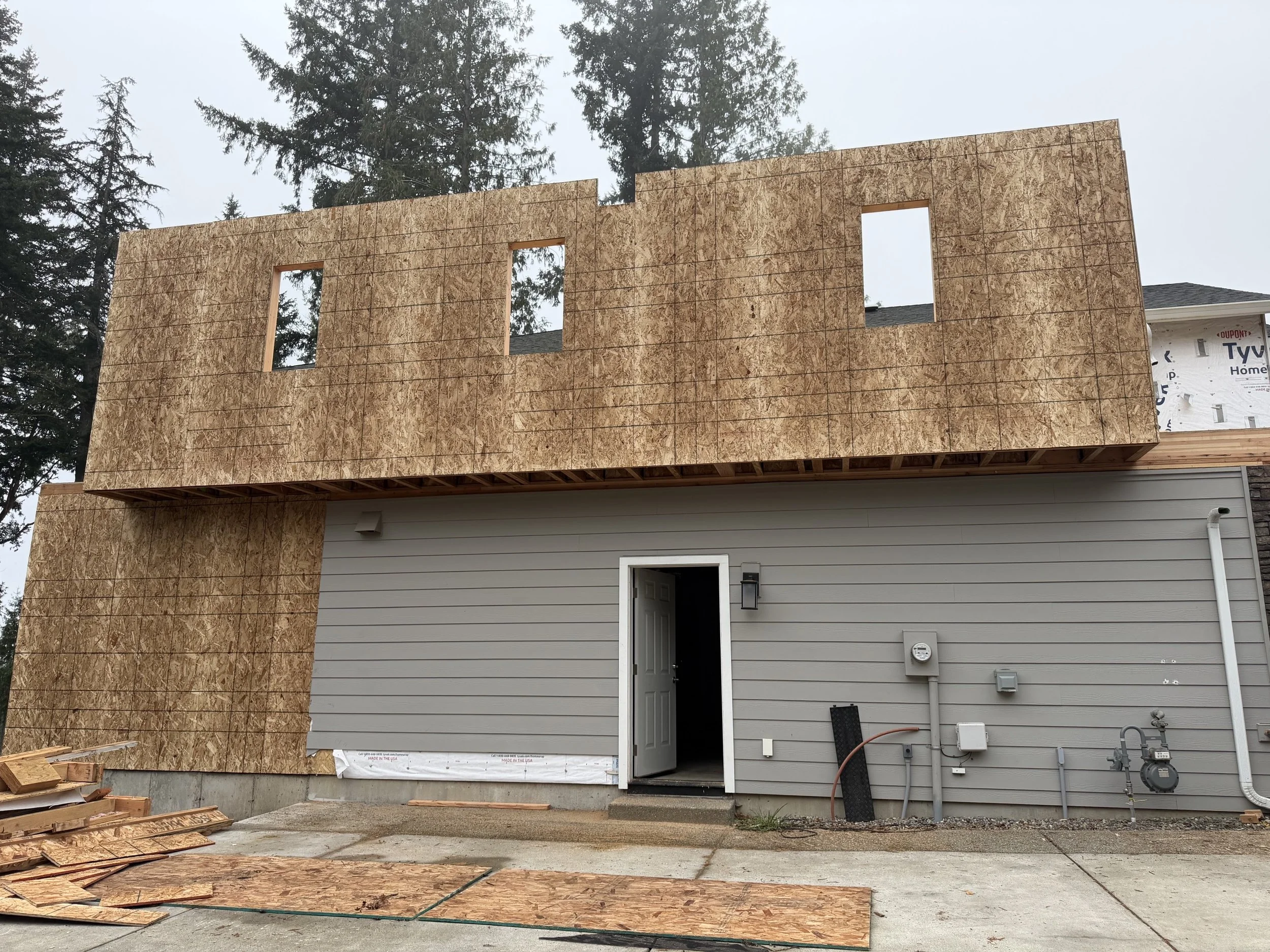
Current second-story addition project in Bremerton!
At some point, many homeowners face the same question: Should we move to a home that better fits our needs, or should we make the home we already love work for us?
Maybe your family is growing, you need a dedicated home office, or you're dreaming of a larger kitchen and more functional living space. Whatever the reason, outgrowing your home doesn't necessarily mean it's time to pack up and move.
For homeowners in Gig Harbor, Tacoma, and throughout Pierce and Kitsap Counties, a home addition can be an excellent alternative to moving. The right choice depends on your budget, your property's potential, your long-term plans, and what matters most to your household.
At Rainier Construction, we help homeowners explore ways to transform their existing spaces into homes that better support their lifestyles. Here is what to consider when deciding whether an addition or a move makes the most sense.
1. You Love Your Location
One of the biggest reasons to consider an addition is that you already love where you live.
Perhaps you are close to work, have great neighbors, enjoy your neighborhood, or have found the perfect spot in Gig Harbor or the surrounding area. Moving could mean giving up the community and convenience you have spent years building.
Finding another home in the same neighborhood with the extra space you need may also be difficult, especially if inventory is limited or home prices are high.
When an addition makes sense: If your current location checks all the boxes but your home no longer meets your needs, expanding your existing home may allow you to enjoy the best of both worlds.
2. The Cost of Moving May Be Higher Than You Expect
Buying another home involves more than the purchase price. Before making a decision, consider the full cost of selling your current home and purchasing a new one.
Expenses may include:
Real estate agent commissions and other selling costs
Closing costs on your next home
Moving services and temporary storage
Repairs, updates, or renovations needed in the new home
Higher property taxes, insurance premiums, or mortgage payments
An addition also requires a significant investment, and the cost will depend on the size, design, structural requirements, finishes, and complexity of the project. However, comparing the total cost of moving with a realistic construction budget can help you make a more informed decision.
When an addition makes sense: If moving would require purchasing a substantially more expensive home, an addition may offer a way to gain the space you need without leaving your current property.
The key is to compare actual numbers rather than assume one option will automatically be less expensive than the other.
3. Your Home Has Room to Grow
Not every property is suited for an addition, but some homes have excellent potential for expansion.
Depending on your existing layout and property conditions, possibilities may include:
A primary suite addition: Create a more spacious bedroom, private bathroom, and additional storage.
A family room expansion: Add comfortable gathering space for entertaining, relaxing, and spending time together.
A second-story addition: Increase your home's square footage while preserving yard space, when the existing structure and site conditions allow.
A home office or guest suite: Create a dedicated workspace or a more comfortable place for visiting family.
A garage or bonus room conversion: Repurpose existing space to meet changing needs, subject to applicable building and permitting requirements.
The best solution depends on your property's layout, structural conditions, setbacks, zoning requirements, and available space.
Before committing to an addition, it's important to evaluate what is feasible and how the new space will integrate with your existing home.
4. You Can Improve More Than Just Square Footage
Sometimes, the issue isn't simply that your home is too small. It may also be that the layout no longer works for your lifestyle.
An addition can provide an opportunity to rethink how your home functions. You might expand a kitchen to create better flow, add a larger living area for entertaining, or connect new and existing spaces to create a more cohesive layout.
Depending on the project, you may also be able to address outdated finishes, improve storage, or make other improvements to the existing home.
At Rainier Construction, we understand that a successful renovation is about more than adding square footage. It's about making the finished space feel intentional, functional, and consistent with the character of the original home.
When an addition makes sense: If you love your home's overall character but need a better layout or additional functionality, an addition combined with a thoughtful renovation may be the right fit.
5. You Want to Stay Long-Term
Your plans for the next five, ten, or twenty years should play a role in your decision.
Consider how your needs may change over time. Are you planning to grow your family? Do you need more room for multigenerational living? Are you working from home more often? Would a more accessible layout help you remain in your home longer?
An addition can be designed around both your current lifestyle and your future needs.
For example, a growing family may benefit from additional bedrooms and shared living space, while homeowners planning to age in place might prioritize a main floor primary suite or improved accessibility.
Thinking beyond your immediate needs can help ensure your investment continues to serve you well.
6. Your Property and Local Regulations Allow for an Addition
Before getting too far into design ideas, it's important to determine whether your property can accommodate the expansion you are considering.
In Washington, requirements can vary by jurisdiction and property. Depending on the location and scope of work, an addition may involve zoning review, building permits, structural engineering, and other approvals.
For properties in Pierce and Kitsap Counties, considerations may include:
Property setbacks and lot coverage limits
Existing structural conditions and foundation capacity
Drainage, grading, and soil conditions
Utility connections and available capacity
Septic system limitations, where applicable
Critical areas, shoreline regulations, or other site-specific restrictions
These factors can affect both the design and cost of a project. A property evaluation and early planning can help identify potential challenges before construction begins.
If your property has significant restrictions, moving may be the more practical option. If the site is well suited for expansion, an addition could be a great opportunity.
7. When Moving May Be the Better Choice
Although an addition can solve many space related challenges, it's not always the right answer.
Moving may make more sense if:
Your current lot cannot accommodate the expansion you need.
Your home requires extensive repairs or major renovations in addition to an addition.
You need significantly more space than your property can reasonably support.
Your lifestyle or work requires relocating to another area.
The cost and complexity of construction outweigh the benefits of staying.
It's also worth considering how long construction may take and how the project will affect your daily routine. Depending on the scope of work, you may be able to remain in your home, or you may need temporary accommodations during certain phases.
The goal isn't to make an addition work at all costs. It's to find the solution that best supports your home, budget, and future.
8. How to Compare Your Options
Before making a final decision, take time to compare the practical and financial implications of both options.
Here are a few questions to discuss with your household:
What do we love about our current home? Identify the features, location, and aspects of your lifestyle that you want to preserve.
What isn't working? Make a list of the specific spaces and functions you need rather than focusing only on square footage.
What is our realistic budget? Consider the total cost of moving alongside the estimated cost of an addition, including design, permitting, construction, and an appropriate contingency.
How long do we plan to stay? An addition may be especially appealing if you expect to enjoy the home for many years.
What is feasible on our property? Understanding zoning, structural requirements, and site conditions early can help narrow your options.
How will the project affect resale? Consider whether the proposed addition is appropriate for the neighborhood and whether the improvements align with your long-term financial goals. No renovation can guarantee a particular return on investment.
Getting answers to these questions will help you approach the decision with greater confidence.
Planning an Addition with Rainier Construction
Deciding between moving and expanding your current home is a big decision, and the best answer looks different for every homeowner.
At Rainier Construction, we believe thoughtful planning is the foundation of a successful project. From evaluating your goals and exploring design possibilities to developing a realistic budget and coordinating construction, our team works to help homeowners understand their options and make informed decisions.
Whether you are considering a new primary suite, a larger family room, or a more extensive home renovation, we can help you explore what may be possible for your property.
We work with homeowners throughout Gig Harbor and surrounding Pierce and Kitsap County communities to create spaces that better fit the way they live.
Thinking about adding space to your home?
Before you start browsing real estate listings, let's explore what your current home could become.
Contact Rainier Construction to discuss your project and take the first step toward a home that works better for you.
Fill out our brief project survey to learn more about our services and get started! https://www.rainierconstructionllc.com/remodels-additions-survey